Two Couples, One Weekend Away: The Smarter Way to Split Costs
Two couples renting a cottage for the weekend. On paper, straightforward — split everything four ways and done. In practice, considerably less so.
One person books the cottage on their card. Someone else fills the car with petrol. One couple does the supermarket run on arrival; the other gets the wine. Saturday night's restaurant bill gets paid by one person and promptly forgotten about. By Sunday afternoon there's a loose approximation of what's owed floating around someone's head, and the most common resolution is "it'll come out in the wash" — which means one couple quietly absorbs more than their share.
The problem isn't that people are bad at maths. It's that the natural unit for settling up isn't four individuals — it's two couples. And most expense apps aren't built with that in mind.
Why individual tracking doesn't match how couples actually settle
Standard expense splitting apps track balances between individuals. That works well for groups of unconnected friends. But couples — and in fact any subgroup that thinks of themselves as a financial unit — don't naturally settle individually. At the end of the weekend, the conversation isn't "Alex owes Sam £23.40 and Jordan owes Sam £18.90." It's "we owe them about £40, shall we just do a transfer?"
When the app produces individual balances and the group wants couple-level settlement, someone ends up doing mental arithmetic on the doorstep of the cottage trying to combine two numbers into one. And then someone else questions the maths. And then the weekend ends on a slightly awkward note that nobody mentions but everyone remembers.
🐾 The real question at the end of a couples trip isn't "what does each person owe?" — it's "what does each couple owe?" Those are different calculations, and the app should handle both.
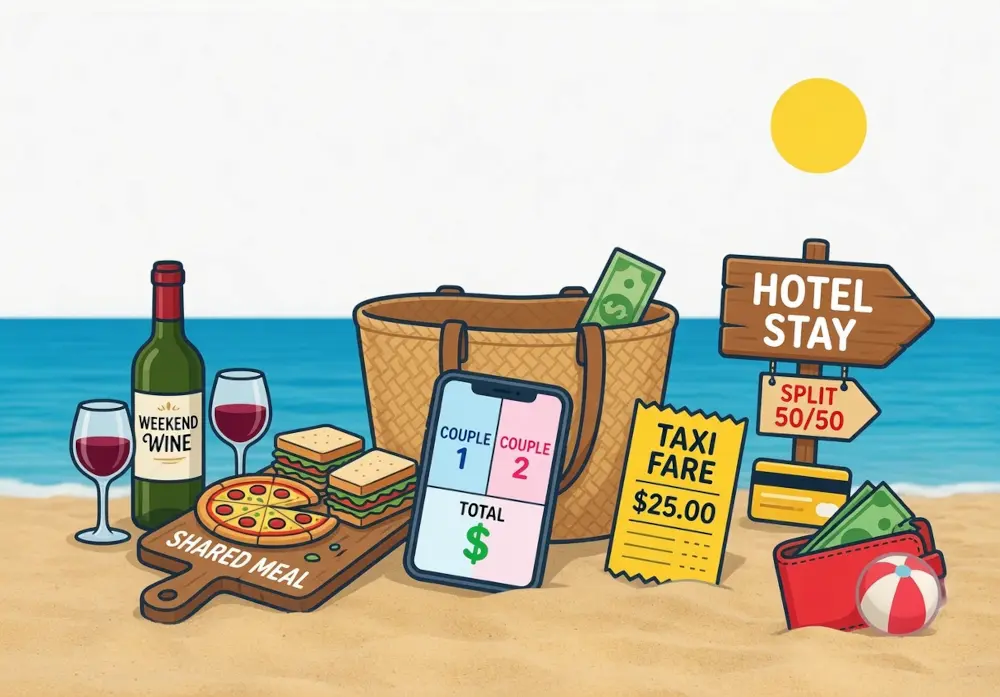
How Tallykins Grouping works
Tallykins has a feature called Grouping that's designed precisely for this. Here's how it works:
Setting up a group
- At any point during the event, the organiser taps to edit the event.
- In the friends list, drag one friend's Tallykin mascot on top of another to create a group.
- Give the group a name — "The Smiths", "Team Blue", whatever works.
- The group is assigned a colour dot, which appears on each member's mascot throughout the app so everyone can see who's in which group at a glance.
- Repeat for any other groups. Groups can have as many members as needed — two couples of two, three friends and a couple of singles, a family of four alongside a pair — any combination works.
Grouping has no effect on how expenses are recorded. Every individual still tracks their own spending throughout the trip, and every balance is calculated individually in the background. Nothing changes about how the weekend works — only how it settles.
Settlement with groups
When it's time to tally up, the Tally Up screen shows group settlement options alongside individual ones. Select group settlement, and Tallykins asks who specifically is paying and receiving on behalf of each group — so one person per couple handles the transfer, rather than four separate payments crisscrossing between individuals.
The result: just one bank transfer. Clear, clean, and done.
🐾 More people joining? The same principles scale up — our guide to splitting holiday costs with a larger group of friends covers the full picture from first deposit to final settlement.
Example: A weekend in the Cotswolds
The group: Two couples — Alex & Sam, Jordan & Ren. All four track expenses individually throughout the weekend using Tallykins.
By Sunday: Alex paid for the cottage. Jordan bought the wine. Sam and Ren split the supermarket run. Various taxis and restaurant bills are logged across all four.
Settlement: The organiser has set up two groups — "Alex & Sam" and "Jordan & Ren". Tally Up shows the net balance between the two couples. Jordan confirms they're paying on behalf of their group; Alex confirms they're receiving. One transfer. Done.
It works for more than couples
The same logic applies to any trip where subgroups share finances more closely than the wider group. A family reunion where each household wants to settle as a unit. A group of eight where four are housemates who'll sort it among themselves. A stag do where the groom's immediate family want to cover his share collectively.
You can create as many groups as the event needs, with as many members as makes sense. People not in a group settle individually as normal. The organiser can set this up at any point — before the trip, during it, or right before settlement. It doesn't need to be planned in advance.
💡 Hidden gem: Grouping is one of those Tallykins features that's easy to miss on a first use — but once you've used it for a couples trip, you'll wonder how you managed without it. Look for it in the event edit screen, in the friends list.
The bigger picture
Good expense tracking doesn't just get the maths right — it matches the social reality of how a particular group of people actually relate to each other and want to settle up. Four individuals who happen to be two couples aren't four strangers splitting a bill. They're two units, and the app should reflect that.
Grouping in Tallykins is a small feature with an outsized effect on how smoothly a weekend ends. No mental arithmetic on the doorstep. No "I'll sort you out next time." Just a clean tally, a couple of transfers, and a weekend worth repeating.
Planning a couples trip? 🐾
Download Tallykins free — Organiser Pass from £3.99, no auto-renewal.