How Do I Calculate Costs Between Friends?
Whether it's a group dinner, a weekend away, or a shared taxi, splitting costs between friends sounds straightforward — until you try to actually work out who owes what. Different people paid for different things. Not everyone was there for every expense. Someone paid more than their share; someone else paid less. By the time you try to tot it all up, it's a mess.
This guide explains exactly how to calculate costs between friends — the maths behind it, how to handle the tricky situations, and how to make the whole thing much simpler going forward.
🐾 Skip the manual maths: The free Who Owes What calculator does exactly this — enter each person's total paid, get a simplified settlement plan in seconds. Works in your browser, nothing stored.
The basic calculation: equal split, one payer
The simplest case: one person pays for everything and the rest owe them their share.
Each person owes = Total cost ÷ Number of people
Then subtract what they've already paid (usually £0 if one person paid everything)Example: dinner for four, one person paid
The restaurant bill is £120. Alex paid. There are four people.
Each person's share = £120 ÷ 4 = £30
Alex paid £120, so Alex is owed £90 total (£30 from each of the other three).
Beth, Chris, and Dana each owe Alex £30.
The more common case: multiple people paid different amounts
In reality, different people usually pay for different things across the course of a trip or event. To work out who owes what, you need to calculate each person's net position.
Net position = Amount paid − Fair share
Positive = owed money back. Negative = owes money to the group.Here's how to do it step by step:
- List every shared expense and who paid for it
- Add up the total of all expenses
- Divide the total by the number of people to get each person's fair share
- For each person, subtract their fair share from the total amount they paid
- Anyone with a positive result is owed money; anyone with a negative result owes money
Example: weekend away, four friends, multiple payers
Expenses:
- Alex paid £200 for the Airbnb
- Beth paid £80 for the supermarket shop
- Chris paid £60 for a group dinner
- Dana paid £0
Total spent: £200 + £80 + £60 = £340
Fair share per person: £340 ÷ 4 = £85
Net positions:
- Alex paid £200 − £85 share = +£115 (owed £115)
- Beth paid £80 − £85 share = −£5 (owes £5)
- Chris paid £60 − £85 share = −£25 (owes £25)
- Dana paid £0 − £85 share = −£85 (owes £85)
Settlement: Beth pays Alex £5. Chris pays Alex £25. Dana pays Alex £85. Everyone is square.
Minimising the number of transfers
In the example above, three separate payments all happen to go to one person. In larger groups it gets more complicated — multiple people are owed money by multiple people, leading to a web of transfers that's confusing and inefficient.
The trick is to simplify: rather than everyone paying everyone else, route transfers through whoever is owed the most. In practice this means:
- List all net positions (who is owed, who owes)
- Match the person who owes the most with the person owed the most
- Settle that pair first, then repeat until all balances are zero
This minimises the total number of bank transfers needed. For a group of six, you can often settle everything in four or five transfers rather than fifteen.
💡 Worth knowing: This debt-simplification calculation is exactly what expense tracking apps do automatically. Working it out manually for a group of more than four people gets complex quickly.
When shares aren't equal
Equal splits only work when everyone benefits equally from every expense. In real group situations that's rarely entirely true. Common scenarios where you need to adjust:
Someone didn't participate. If one person didn't go on the activity or skipped the restaurant, they shouldn't pay for it. Remove them from that expense before dividing.
Different room types. If two people had the larger room and two had the smaller, split the accommodation cost proportionally rather than equally.
Individual choices at a restaurant. For shared starters and communal bottles, split equally. For individual mains, assign the cost to the person who ordered.
Someone arrived late or left early. Only include them in expenses that occurred while they were present.
Example: restaurant bill, one non-drinker
Four friends at dinner. Total bill: £160. This includes £60 of wine that only three of the four drank.
Food portion: £100 ÷ 4 = £25 each
Wine portion: £60 ÷ 3 = £20 each (for the three who drank)
Result: The non-drinker pays £25. The three drinkers each pay £45. Total still adds up to £160.
🐾 Uneven splits become necessary when individual choices create a meaningful difference for friends in the group. See our guide to splitting expenses fairly when shares aren't equal for how to handle these situations.
Handling rounding
When a total doesn't divide evenly — say, £100 split between three people — you get recurring decimals (£33.33...). In practice, someone has to absorb an extra penny. The fairest approach is to round most shares down and give one person the slightly higher amount, rotating who gets the odd penny each time if it comes up repeatedly.
For most group trips the rounding difference is small enough that it doesn't matter — just round to the nearest pound and move on. Spending twenty minutes arguing over 2p costs everyone more in goodwill than it saves in money.
When expenses are in different currencies
International trips add a layer of complexity that breaks most manual calculation attempts. Different expenses are paid in different currencies, exchange rates fluctuate day to day, and you need everything converted to one consistent currency before the final balances make any sense.
The manual process looks like this:
- For each expense paid in a foreign currency, find the exchange rate that applied on the day it was paid
- Convert the amount to your base currency (usually the home currency of most of the group)
- Use the converted figure in all your balance calculations
- Repeat for every foreign currency expense across the whole trip
The problem is that exchange rates change daily, and the rate on day one of the trip is different from the rate on day five. If you use a single rate for everything, someone is slightly disadvantaged. If you use the correct daily rate for each transaction, you're looking up exchange rates for every individual expense — which is impractical on holiday and error-prone after the fact.
Example: a trip spanning two currencies
Four friends spend a long weekend partly in the UK and partly in France.
- Alex paid £180 for the ferry crossing (GBP — no conversion needed)
- Beth paid €240 for the French Airbnb (rate on that day: £1 = €1.17, so €240 = £205.13)
- Chris paid €95 for group dinners in France (same rate: €95 = £81.20)
- Dana paid £40 for fuel (GBP — no conversion needed)
Total in GBP: £180 + £205.13 + £81.20 + £40 = £506.33
Fair share: £506.33 ÷ 4 = £126.58 each
And that's before accounting for anyone being excluded from specific expenses, or the exchange rate having moved between Beth's payment and Chris's.
💡 The conversion trap: If you wait until the end of the trip to convert currencies, you'll be using whatever today's rate is — which may be meaningfully different from the rate when each expense was actually paid. For accurate calculation, you need the rate at the time of each transaction.
When two friends want a combined tally
Couples, family members, or close friends often think of themselves as a single financial unit — they'll settle as one entity rather than making separate individual payments. Calculating a combined tally for a subgroup within a larger group adds another layer of arithmetic.
Here's what's involved manually:
- Calculate each individual's net position within the group as normal
- For each subgroup (say, a couple), add together the net positions of both members
- The combined figure is what that couple owes or is owed as a unit
- Decide which member of the couple makes or receives the actual payment
Example: two couples, one weekend, combined settlement
Individual net positions after full calculation:
- Alex: +£62 (owed £62)
- Sam (Alex's partner): −£18 (owes £18)
- Jordan: −£30 (owes £30)
- Ren (Jordan's partner): −£14 (owes £14)
Combined couple positions:
- Alex & Sam together: +£62 − £18 = +£44 (their couple is owed £44)
- Jordan & Ren together: −£30 − £14 = −£44 (their couple owes £44)
Settlement: Jordan transfers £44 to Alex. One payment. Done.
Without the combined calculation, you'd have three separate transfers between four people — and the mental arithmetic to work out which direction each one goes.
Extend this to three or four subgroups within a larger group — some couples, some individuals, perhaps a family of three — and the manual calculation requires keeping several parallel sets of numbers accurate simultaneously. One mistake in the individual balances cascades through every combined figure.
The problem with doing this manually
Take everything above — multiple payers, uneven shares, foreign currencies at daily exchange rates, and combined subgroup balances — and try to do it with a spreadsheet or a notes app at the end of a holiday when you're tired and ready to go home. It's a recipe for errors, disputes, and the resigned "let's just call it even" that leaves someone quietly out of pocket.
🐾 A simpler approach: Log each expense as it happens — who paid, how much, in what currency, who it's split between. A group expense app does all the arithmetic in real time, including currency conversion and subgroup balances, so by the end of the trip the settlement figures are already calculated correctly. No reconstruction required.
How Tallykins calculates it for you
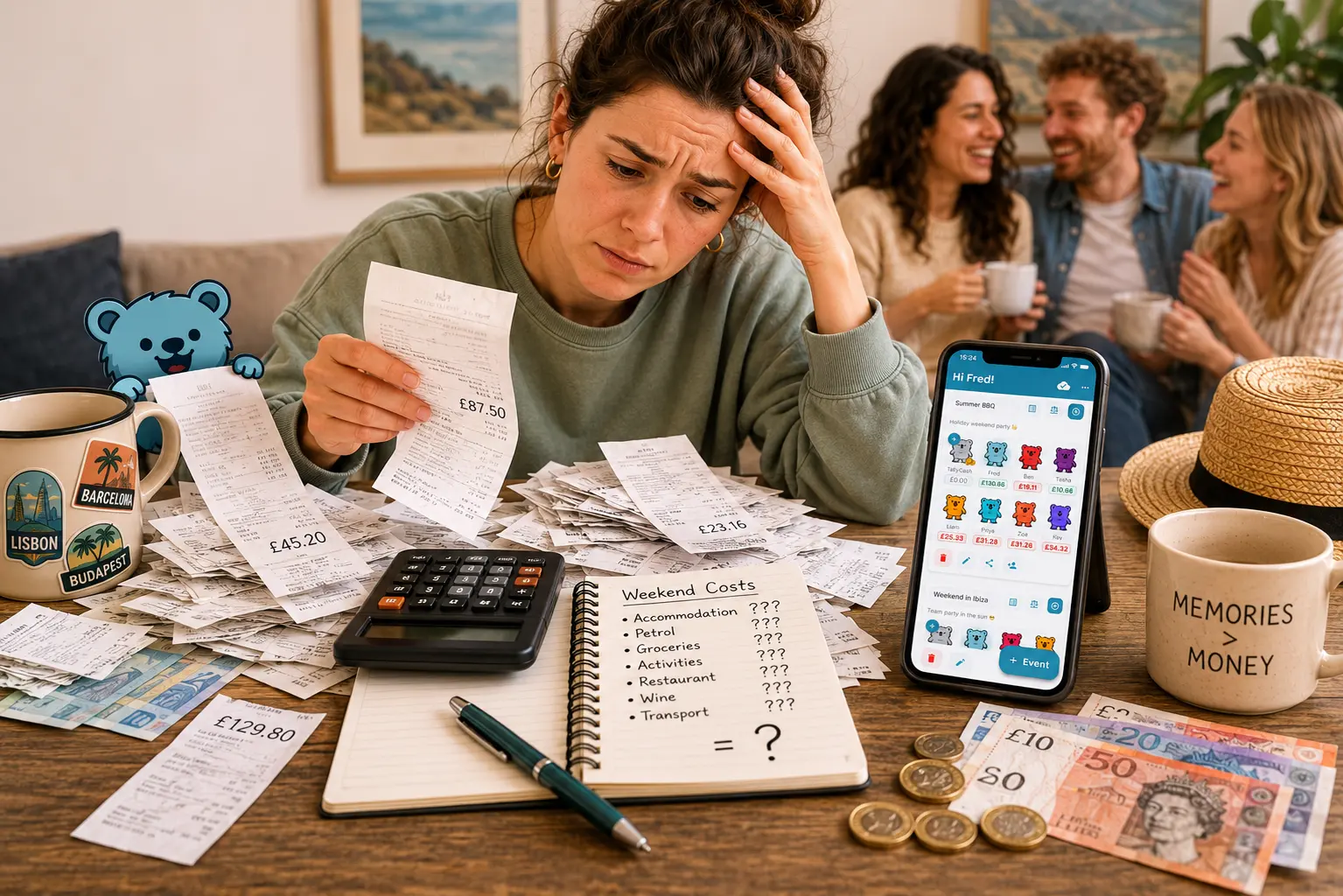
In Tallykins, you log each expense at the time it's paid. Tap who paid, enter the amount, confirm who it's split between — everyone equally by default, or custom amounts if shares differ. The app applies the net position calculation automatically for every person in the group, updating in real time as new expenses are added.
For multi-currency trips, you log the amount in whatever currency is shown on the receipt. Tallykins converts everything to your chosen base currency using exchange rates updated each weekday across 29 supported currencies — no manual lookups, no end-of-trip conversion guesswork.
For groups that include couples or other subgroups settling together, the Grouping feature handles the combined tally automatically. At any point the organiser can drag friend mascots together to form a named group. At settlement, the Tally Up screen shows the net position for each group as a unit — and asks who specifically is making or receiving the payment on the group's behalf. What would be several transfers between individuals becomes one transfer between couples.
The Tally Up screen shows a simplified final list with the number of transfers minimised automatically. The organiser sets up the shared event by linking their existing Google or Apple account. Everyone else joins with a six-digit code — no email, no password, nothing to sign up for.
Let Tallykins do the maths 🐾
Download free — Organiser Pass from £3.99, no auto-renewal.